
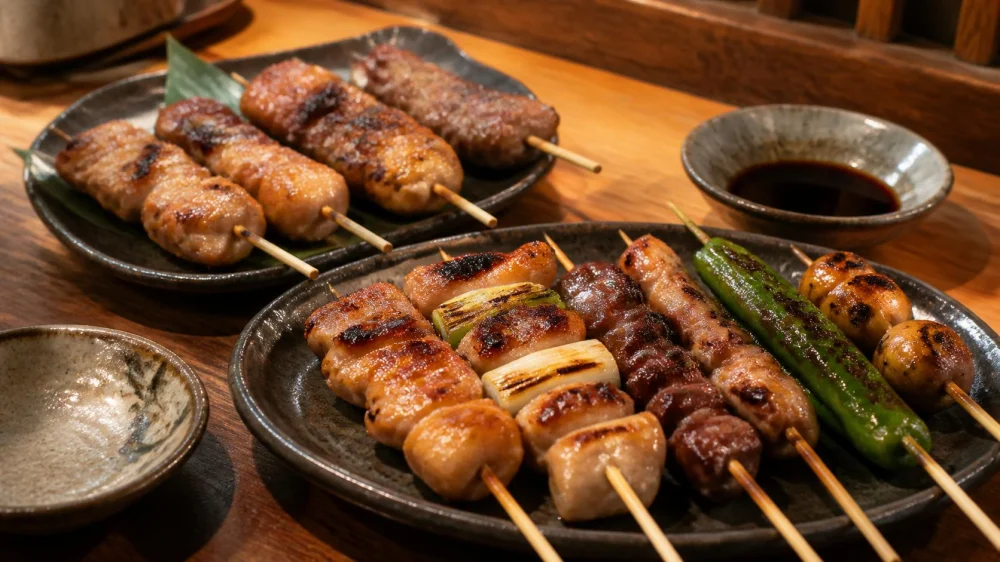
Yakitori Ordering Guide: Cuts, Doneness, and Sharing
On this page
Quick answer
For a balanced yakitori order, combine familiar lean pieces with one or two richer cuts, choose salt or tare according to the ingredient, add vegetables or a simple side, and order in small rounds while the skewers are hot. Ask the restaurant about ingredients, allergens, and doneness; poultry should be prepared according to applicable food-safety guidance.
Yakitori generally refers to bite-size chicken pieces grilled on skewers, often over charcoal and seasoned with salt or a savory-sweet tare sauce. Menus may include different muscles, skin, organs, meatballs, and vegetables, and names or preparation styles can vary by restaurant.
What yakitori is
This guide is for diners in the United States who want to understand a yakitori menu and build a shared meal. It is not a substitute for the restaurant's allergen information or food-safety procedures.
Part of yakitori's appeal is contrast. Breast or tenderloin can be mild and lean; thigh is often juicier; skin offers crispness and richness; meatballs provide a different texture; and organ cuts can have stronger flavor. Vegetable skewers, rice, pickles, or soup can create balance when available.
Some places specialize in chicken skewers, while others use “yakitori” more broadly for assorted grilled items. Read the menu description and ask what is included rather than assuming every skewer contains the same ingredients.
How to read the choices
- Lean cuts: Often mild and a comfortable starting point, but preparation affects moisture and texture.
- Thigh and mixed cuts: Usually fuller in flavor and useful as the center of a varied order.
- Skin: Chosen for crisp and fatty texture; best in a smaller quantity if the table wants contrast.
- Meatballs: May contain seasoning, binder, sauce, or other ingredients, so ask about allergens.
- Organ skewers: Can be mineral, rich, firm, or tender depending on the part; ask staff for a mild-to-bold progression.
- Negima and combinations: Chicken may alternate with scallion or another vegetable, adding sweetness and texture.
- Salt versus tare: Salt keeps the ingredient prominent; tare adds gloss, sweetness, and savory depth. Neither is universally better.
A practical ordering plan
- Tell the server the group size, appetite, allergies, avoided ingredients, and willingness to try organ cuts.
- Begin with a small mix of mild, rich, crisp, and vegetable skewers instead of ordering many identical pieces.
- Ask whether skewers are sold individually, in pairs, or as a chef-selected set.
- Request the restaurant's normal safe doneness; do not ask staff to ignore required food-safety practices.
- Eat each round while hot, then decide whether to repeat favorites or add a bolder cut.
- Add rice, soup, vegetables, or another simple dish if the table needs a more complete meal.
Best for first-timers: A mixed set with staff guidance reduces guesswork. Not ideal for strict ingredient control: A preset assortment may be harder to customize, so ordering individual skewers can be clearer.
How to choose a restaurant
For local discovery, compare menu detail, recent hours, reservation options, service style, price transparency, allergy communication, accessibility, and review patterns. Photos can show presentation but cannot prove food safety or quality. Verify important details directly with the restaurant.
A focused yakitori restaurant may offer more cuts and a paced skewer service. A broader Japanese restaurant may be better when a group wants sushi, noodles, or vegetarian choices too. Choose based on the table's needs rather than an unsupported “best” label.
Important safety and dining notes
Chicken and organ meats require careful handling and cooking. Follow current public-health guidance and the restaurant's safe preparation practices. People who are pregnant, older, immunocompromised, or otherwise at higher risk from foodborne illness should seek appropriate professional guidance about undercooked foods.
Tare, meatballs, marinades, and shared grills may involve soy, wheat, egg, sesame, or other allergens. Cross-contact can occur. Describe the allergy clearly and ask whether the restaurant can accommodate it; if staff cannot answer confidently, choose a safer alternative.
Evidence note: The ordering framework reflects common Japanese dining terminology and general food-safety principles. Recipes, names, cooking methods, and ingredient handling differ by establishment.
Frequently asked questions
How many skewers should one person order?
There is no universal number. Appetite, skewer size, sides, and meal format vary. Start with a small round and add more as needed.
Is tare always sweet?
It is commonly savory-sweet, but the balance and ingredients vary. Ask if sweetness, alcohol-derived ingredients, soy, or wheat matters to you.
Are all yakitori dishes chicken?
Traditional yakitori centers on chicken, but some menus group vegetables or other grilled skewers nearby. Check each description.
Can yakitori work for a mixed-preference group?
Yes when the menu offers individual ordering and suitable sides, but confirm vegetarian preparation and cross-contact rather than assuming.
Should skewers be shared?
They can be shared if the group is comfortable and uses clean serving practices. Individual skewers are simpler for allergies and preferences.
Conclusion and next steps
Review the menu, identify safe choices, and build contrast across lean, juicy, crisp, bold, and vegetable items. Order a small first round, eat it hot, and adjust. Direct questions about ingredients, cross-contact, portion format, and safe doneness will produce a more useful meal than relying on assumptions.


 Maneki Neko Japanese Restaurant4.0 (557 reviews)
 Sushi Den4.0 (418 reviews)
 Matsu4.0 (602 reviews)
 IJ Sushi Burrito -Westlake center3.0 (87 reviews)
 Naruto 5054.0 (31 reviews)
 Little Tokyo Restaurant3.0 (48 reviews)
 A Foodie’s Experience at Tekka Japanese Restaurant
 Why Japanese Restaurant Las Vegas Is a Must-Try Spot for Japanese Food Lovers
 What Makes a Japanese Restaurant SF Stand Out Among Japanese Restaurants
 Why Fujiya Japanese Restaurant Is a Must-Try Spot for Japanese Food Lovers
 Donburi Guide: Choose a Balanced Japanese Rice Bowl
 What Makes Japanese Restaurant Chicago Stand Out Among Japanese Restaurants