
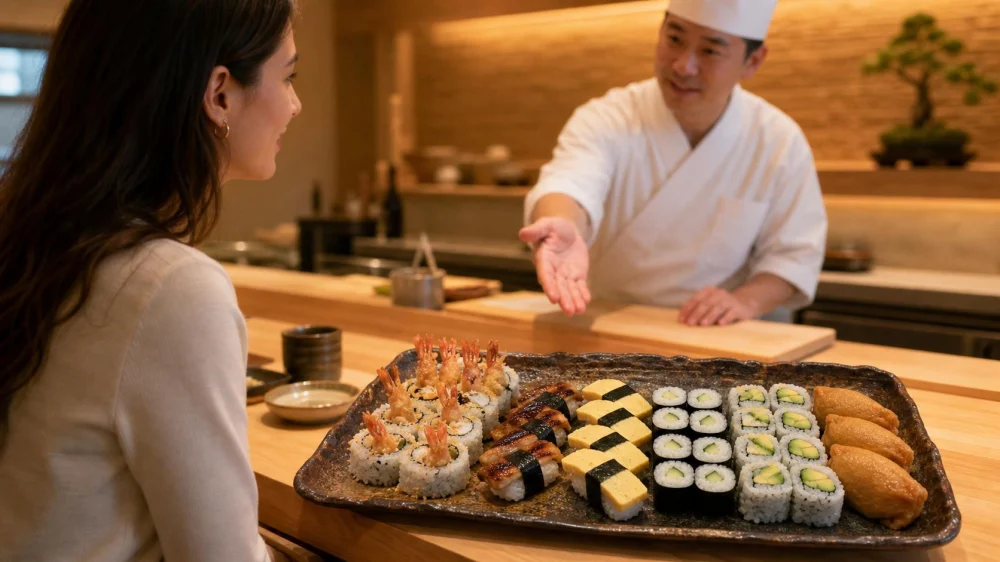
How to Order Sushi When You Do Not Eat Raw Fish
On this page
Quick answer
You can enjoy sushi without raw fish by ordering rolls, nigiri, or hand rolls made with fully cooked seafood, cooked egg, tofu, or vegetables. Ask whether every filling and topping is cooked, because seared, smoked, marinated, or tempura-style names do not always guarantee that. If avoidance is medical or allergy-related, explain it clearly and ask about shared knives, boards, fryers, sauces, and preparation surfaces before deciding.
Sushi does not always mean raw fish
Sushi is seasoned rice served with or around toppings and fillings; raw fish is optional, not the definition. Sashimi, by contrast, is sliced fish or seafood served without sushi rice and is often raw.
A Japanese restaurant in the United States may offer traditional items, regional adaptations, and house-created rolls. Names are not standardized across every menu, so ingredients and preparation should be confirmed at the specific restaurant.
Menu words to understand
- Nigiri: a hand-formed portion of sushi rice with a topping; the topping may be raw, cooked, or prepared another way.
- Maki: a sliced roll, usually wrapped with nori; fillings vary widely.
- Temaki: a cone-shaped hand roll with rice and fillings.
- Gunkan: rice wrapped with nori to hold a loose topping, which may be raw or cooked.
- Aburi or seared: surface-torched or seared; the center may remain raw.
- Smoked or cured: processed for flavor and preservation, but not necessarily cooked.
- Tempura: battered and fried, though a finished roll may still include raw toppings or sauces.
Ask a direct question: “Is every seafood ingredient in this item fully cooked, including the topping and sauce?”
Cooked seafood choices
Common possibilities include cooked shrimp, steamed or boiled crab, imitation crab, grilled eel, cooked scallop, fried shrimp tempura, or fully cooked fish. Availability and recipes vary.
Check these details:
- Imitation crab often contains fish and may also contain wheat, egg, or other ingredients.
- Eel sauce, spicy sauce, and house glazes can contain soy, wheat, egg, sesame, or other allergens.
- A shrimp-tempura roll may be topped with raw tuna, salmon, roe, or a raw seafood mixture.
- “Cooked crab” may be imitation crab rather than shellfish, or it may be mixed with mayonnaise.
- Seared seafood can remain raw inside unless the restaurant confirms full cooking.
Cooked options are best for diners avoiding raw seafood by preference. They are not automatically suitable for a fish or shellfish allergy.
Vegetable and egg choices
Potentially seafood-free sushi includes cucumber roll, avocado roll, pickled radish roll, cooked mushroom roll, asparagus roll, inari sushi made with seasoned tofu pockets, and tamago nigiri made with cooked egg.
However, recipes can include fish-based dashi, fish flakes, oyster sauce, imitation crab, mayonnaise, or shared garnishes. Some sushi rice seasoning and sauces may also matter for dietary restrictions. A vegetarian menu label is helpful but should not replace an allergy conversation.
Questions to ask before ordering
- Does this item contain any raw or undercooked fish, shellfish, roe, or topping?
- Is “seared” seafood cooked all the way through?
- What is inside the seafood salad, spicy mixture, or house sauce?
- Does the roll use imitation crab or fish-based stock?
- Is tempura fried in oil shared with seafood or another allergen?
- Can the kitchen use clean utensils and a clean preparation surface if cross-contact matters?
- Can the restaurant safely meet this request? If not, what packaged or separately prepared option is safer?
Use plain language rather than only saying “no raw.” For example: “I need all seafood fully cooked, including toppings and mixtures.” For an allergy, name the allergen and the seriousness of cross-contact.
Allergies and cross-contact
Allergen cross-contact is the unintended transfer of an allergen into another food through shared ingredients, hands, utensils, equipment, oil, or surfaces. Removing a visible topping does not undo cross-contact.
Sushi counters often prepare many fish, shellfish, egg, sesame, soy, and wheat ingredients in a compact workspace. If you have a diagnosed allergy:
- tell the server and ask that the kitchen or chef be informed;
- ask about ingredients and shared preparation, not only the menu name;
- do not rely on appearance or a companion tasting the food;
- follow your clinician’s emergency plan and carry prescribed medication;
- choose another restaurant if staff cannot confidently explain or manage the risk.
A seafood-free ingredient can still be unsafe when prepared on a shared sushi mat or board. Individual restaurants decide what controls they can reliably provide.
A simple first-order plan
- Start with one clear category: fully cooked seafood or no seafood.
- Choose a simple roll: fewer fillings make questions easier.
- Confirm toppings and sauces: hidden seafood is often added after rolling.
- Add a cooked side: miso soup, edamame, rice, grilled items, or noodles may round out the meal, subject to ingredients and dietary needs.
- Order modestly: try one or two items before choosing unfamiliar textures or strong sauces.
A practical beginner order might be a cucumber or avocado roll plus a fully cooked shrimp roll after confirming ingredients. It is not a universal allergy-safe order.
Food safety limitations
FDA guidance says thorough cooking is the safest route for seafood because freezing does not eliminate all harmful germs. Pregnant people, young children, older adults, and people with weakened immune systems are at higher risk of severe foodborne illness and should avoid raw or undercooked seafood.
Cooking status does not address every concern, including mercury choices, sodium, allergies, celiac disease, religious practice, or individualized medical advice. Ask an appropriate healthcare professional about personal restrictions. Seek urgent care for severe allergic symptoms or serious illness after eating.
Frequently asked questions
Is a California roll raw?
It commonly uses cooked or imitation crab, but recipes and toppings vary. Ask whether every seafood component is cooked and whether raw fish or roe is added.
Is smoked salmon considered cooked?
Not necessarily. Smoking methods vary, and refrigerated smoked seafood may not be cooked to a temperature that suits someone avoiding undercooked seafood. Ask the restaurant.
Is tempura sushi always fully cooked?
No. The fried filling may be cooked while another filling, topping, or sauce contains raw seafood. Confirm the complete item.
Can vegetarians safely order vegetable rolls?
Often, but fish-based stock, sauces, garnishes, and shared surfaces may matter. Explain the restriction and ask how the item is prepared.
Does freezing make raw sushi risk-free?
No. FDA notes that freezing can kill parasites under appropriate conditions but does not kill all harmful germs. Thorough cooking remains the safer route.
Sources and evidence notes
US Food and Drug Administration seafood guidance states that thorough cooking minimizes foodborne illness risk and that freezing does not kill every harmful germ. FDA materials identify raw or undercooked seafood as a food to avoid for higher-risk groups.
FDA food-allergy materials define and address allergen cross-contact. These sources support the safety boundaries here; the restaurant is the source for its current recipes and preparation controls, while a clinician provides individualized medical advice.
Next steps
Before visiting, review the current menu and mark two simple candidates. At the restaurant, state whether raw avoidance is a preference, pregnancy or health precaution, or allergy. Confirm every filling, topping, sauce, and preparation surface that matters.
Sushi without raw fish is not a compromise category. It is a broad set of cooked and plant-based choices—provided the full recipe matches your needs.


 Xaga Sushi & Asian Fusion4.0 (334 reviews)
 Coast Sushi & Sashimi4.0 (143 reviews)
 New Suki Ichiro Sushi4.0 (367 reviews)
 Oni Ramen4.0 (1952 reviews)
 Kuro-Obi Ramen CK by Ippudo3.0 (64 reviews)
 Sushi Q4.0 (317 reviews)
 Why Locals Recommend Kazu Japanese Restaurant
 What to Eat at a Japanese Restaurant on Whole30 – Best Compliant Choices
 Signature Sushi and Ramen at Top Japanese Restaurants in NYC
 A Foodie’s Experience at Domo Japanese Country Food Restaurant
 Why Kiku Japanese Restaurant Is a Must-Try Spot for Japanese Food Lovers
 A Foodie’s Experience at Mt. Fuji Japanese Restaurant | Authentic Japanese Cuisine