
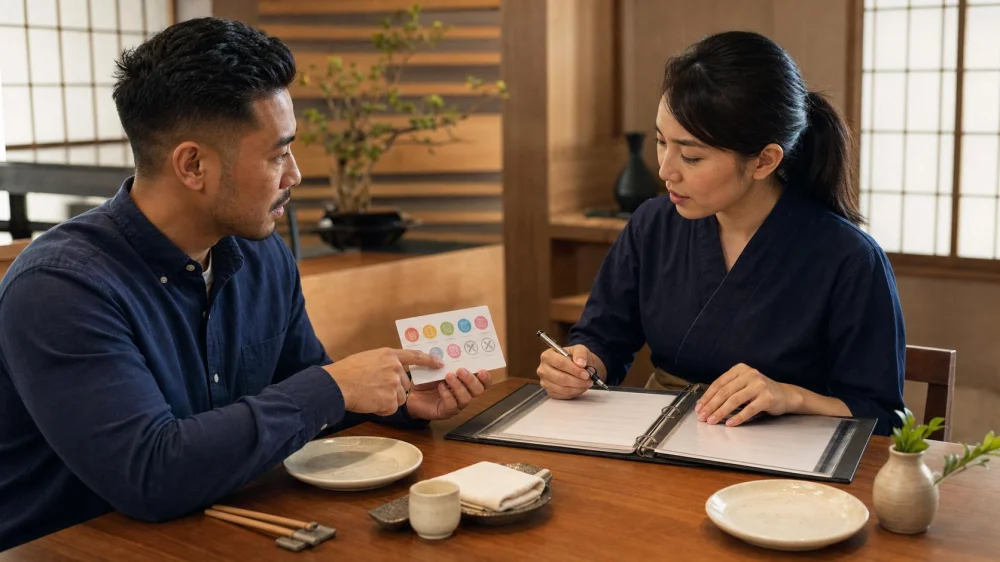
Food Allergies at a Japanese Restaurant: Safer Questions
On this page
Quick answer
When dining with a food allergy at a Japanese restaurant, name the exact allergen and ask about every component: broth, sauce, seasoning, marinade, garnish, cooking surface, fryer, and serving utensil. Do not assume a plain-looking dish is safe. If staff cannot verify ingredients and cross-contact controls with the kitchen, the safer decision may be to choose another dish or restaurant.
This guide is for diners in the United States who already know their allergens and personal emergency plan. It cannot determine whether a particular meal is safe for you and does not replace advice from your allergist or other qualified clinician.
Name the exact allergen
The U.S. Food and Drug Administration recognizes nine major food allergens: milk, egg, fish, Crustacean shellfish, tree nuts, peanuts, wheat, soybeans, and sesame. People can also react to foods outside this list.
Say “I have an allergy to soy” or “I must avoid wheat,” not only “I have dietary restrictions.” If relevant, distinguish:
- Fish from Crustacean shellfish such as shrimp or crab
- A specific tree nut from peanuts
- Wheat allergy from celiac disease or another gluten-related need
- Milk allergy from lactose intolerance
- An allergy from a vegetarian, vegan, religious, or preference-based request
These conditions may lead to similar ingredient questions but do not have identical risk or preparation requirements. Avoid asking staff to infer what “allergy-friendly” means for you.
Know where ingredients may appear
Japanese restaurant menus vary widely across the United States. Recipes also differ by restaurant, chef, supplier, and location. Use the examples below as question prompts, never as a safe or unsafe list.
Soy and wheat
Soy sauce commonly contains soy and may contain wheat. It can appear in dipping sauces, soup bases, marinades, glazes, dressings, simmered dishes, fried-rice seasoning, and finishing sauces. Miso, tofu, edamame, soy milk, kinako, and some mayonnaise or processed ingredients may also contain soy.
If you must avoid wheat or gluten, ask about soy sauce, noodles, tempura batter, bread crumbs, imitation seafood, curry roux, dumpling wrappers, and packaged seasonings. A dish served without noodles or bread can still use a wheat-containing sauce.
Fish and shellfish
Dashi and other broths may use fish-based ingredients even when the visible dish contains vegetables, tofu, egg, or noodles. Fish flakes, fish roe, fish cakes, anchovy-derived seasonings, and seafood-based sauces can appear in toppings and garnishes.
Crab, shrimp, scallop, and other seafood may share cutting boards, knives, grills, pans, fryers, or plating areas. Imitation crab can contain fish and may include other ingredients that need verification.
Sesame, egg, milk, peanuts, and tree nuts
Sesame seeds, sesame oil, or sesame paste may be used in dressings, sauces, noodles, vegetables, and garnishes. Egg may appear in batters, mayonnaise-style sauces, noodles, custards, omelets, and toppings. Milk can be present in desserts, creamy sauces, breaded foods, curry, or modern fusion dishes.
Peanuts and tree nuts are not universal ingredients in Japanese cuisine, but they can appear in desserts, toppings, dressings, specialty sauces, or fusion recipes. Verify the restaurant’s actual recipe and supplier label.
Ask about cross-contact
Allergen cross-contact is the unintentional transfer of an allergen into food that was not meant to contain it. Removing a visible topping after plating does not remove transferred allergen protein.
Ask the kitchen about the specific paths that matter for your order:
- Is the same fryer used for tempura, breaded items, seafood, or other allergens?
- Are grills, flat-tops, pans, pots, or cooking water shared?
- Are sushi knives, cutting boards, rolling mats, gloves, or rice paddles shared?
- Are sauces applied with shared brushes, bottles, ladles, or spoons?
- Can a clean preparation surface and clean utensils be used?
- Can the order be kept separate during garnishing, plating, and pickup?
“Cooked at high heat” is not an adequate cross-contact answer. Neither is “we can pick it off.” Ask what the restaurant can actually change in its workflow and whether staff can carry the request from server to kitchen to final delivery.
Call before you go
Contact the restaurant outside its busiest service period when possible. Ask to speak with a manager or kitchen staff member who knows recipes and preparation practices.
Use the call to learn:
- Whether ingredient lists or recipes are available for the dishes you are considering
- Whether sauces, broth, noodles, and other components are made in-house or arrive packaged
- Whether supplier labels can be checked
- Whether the kitchen has a process for allergy orders
- Whether clean equipment or a separate preparation area is feasible
- Which time or location is best able to handle the request
- Who will confirm the plan when you arrive
Ask about the current menu, not a photo or review from a previous visit. Recipes, brands, and kitchen practices can change. A successful meal in the past does not guarantee that the next order has the same ingredients or cross-contact conditions.
Use a clear ordering script
A concise script reduces ambiguity:
“I have a serious allergy to [allergen]. I cannot eat foods that contain it or foods that contact shared [equipment or surface, if relevant]. Could you please check the ingredients in the broth, sauce, seasoning, garnish, and packaged components, and ask the kitchen whether this dish can be prepared with clean utensils and a clean surface?”
Then ask the server to repeat the allergen and requested controls back to you. If a manager confirmed a plan by phone, give the name and explain the arrangement. Do not rely solely on an allergy card, translated note, reservation comment, or app; use it to support a direct conversation.
Avoid giving the kitchen a long list of substitute recipes unless staff asks. First identify a dish with few components, then verify each component and preparation step. A simple order may be easier to evaluate, but “simple” does not automatically mean safe.
Decide whether to order
Choose a dish only when staff can give specific, consistent answers about ingredients and cross-contact controls that fit your needs. Good answers sound like:
- “The chef checked the label and this sauce contains soy and wheat, so we cannot use it.”
- “The fryer is shared with shrimp tempura, so we cannot prevent shellfish cross-contact for fried foods.”
- “We can use a clean pan and utensils, but the broth is pre-made and contains fish.”
Pause or leave when answers remain vague, staff minimize the allergy, the kitchen is too busy to confirm, or the proposed solution is to remove an ingredient after cooking. Honest limits are more useful than reassurance without a verified process.
If the restaurant cannot accommodate you, do not pressure staff to improvise. Ask whether an unopened packaged item with a label, a different location, or another time offers a verifiable option. Otherwise choose a restaurant better prepared for your needs.
At-the-table checklist
- Carry the emergency medication prescribed for you and follow your personal care plan.
- Tell the server and manager the exact allergen.
- Confirm every sauce, broth, seasoning, garnish, and packaged component.
- Ask about relevant shared fryers, grills, water, tools, surfaces, and plating.
- Verify the allergy request is attached to the correct order.
- When food arrives, ask the server to confirm which plate was specially prepared.
- Do not taste a dish to test whether it contains an allergen.
- If the plate has an unexpected garnish, sauce, or appearance, stop and recheck.
Limitations and safety notes
Most foods sold in restaurants are not packaged-food labels governed in the same way as retail packages. A menu icon or “allergy-friendly” description may not explain ingredient sourcing or shared preparation. Ask what the restaurant means and how the dish is prepared.
No restaurant conversation can create zero risk. Your allergen, reaction history, and tolerance to cross-contact are individual medical matters. Follow your clinician’s advice about avoidance and emergency readiness.
If you believe you are having an allergic reaction, follow your emergency plan and seek emergency help. Do not wait for restaurant staff to identify the ingredient or decide whether symptoms are serious.
Sources and evidence notes
- The FDA’s food allergy resource identifies the nine major allergens and defines cross-contact as unintended allergen presence.
- The CDC’s restaurant food allergy practices summary highlights staff training, ingredient lists, cleaned or separate preparation resources, and a restaurant plan for allergy orders.
- The FDA’s consumer information on gluten-free claims recommends asking what the restaurant means, which ingredients are used, and how the item is prepared.
The dish examples in this article are question prompts based on common ingredient patterns. Only the restaurant can describe its current recipes and kitchen practices.
Frequently asked questions
Is plain sushi rice free from major allergens?
Do not assume so. Ask what is added to the rice and whether utensils, containers, gloves, or preparation surfaces are shared. Also verify every topping, filling, sauce, and garnish.
Is tamari always safe for someone avoiding wheat?
No product name alone is enough. Ask staff to check the exact package label and preparation process. If gluten is the concern, also ask about shared containers, brushes, and surfaces.
Can a restaurant make tempura safe by changing the batter?
Changing batter addresses only one ingredient question. The fryer, oil, utensils, preparation surface, sauces, and other components may create additional concerns. Verify the complete process.
Does “vegetarian” mean fish-free?
Not necessarily. Definitions and recipes vary, and a dish without visible meat may use fish-based broth or seasoning. Ask specifically about fish and the ingredients that matter to you.
Should I use a translated allergy card?
It can support communication, especially when language is a barrier, but it should not replace a conversation with a knowledgeable staff member about ingredients and cross-contact.
Conclusion and next steps
Choose one or two candidate dishes before visiting, then call to verify ingredients and preparation. At the restaurant, repeat the exact allergen, confirm the kitchen plan, and recheck the plate before eating. When staff cannot give specific answers that meet your needs, treat that uncertainty as information and choose a safer alternative.


 Unagi Hibachi Grill5.0 (2 reviews)
 KOJIMA5.0 (9 reviews)
 Gorilla Sushi Bar On Clark4.0 (398 reviews)
 Mizu 21 Restaurant4.0 (201 reviews)
 Sushi Sake Sunset4.0 (904 reviews)
 Sushi Yama (Yama Japanese Restaurant)4.0 (455 reviews)
 A Foodie’s Experience at Yama Japanese Restaurant: A Culinary Journey
 How to Reheat Tempura Without Making It Soggy Using Oven, Air Fryer, Toaster Oven
 A Foodie’s Experience at Aki Japanese Restaurant – A Culinary Delight
 The Complete Guide to Dining at Wako Japanese Restaurant
 Why Oishi Japanese Restaurant Is a Must-Try Spot for Japanese Food Lovers
 Top Dishes You Should Order at Miyako Japanese Restaurant | Japanese Restaurant