
Why Japanese Restaurants Offer a Towel Before Your Meal
On this page
Quick answer
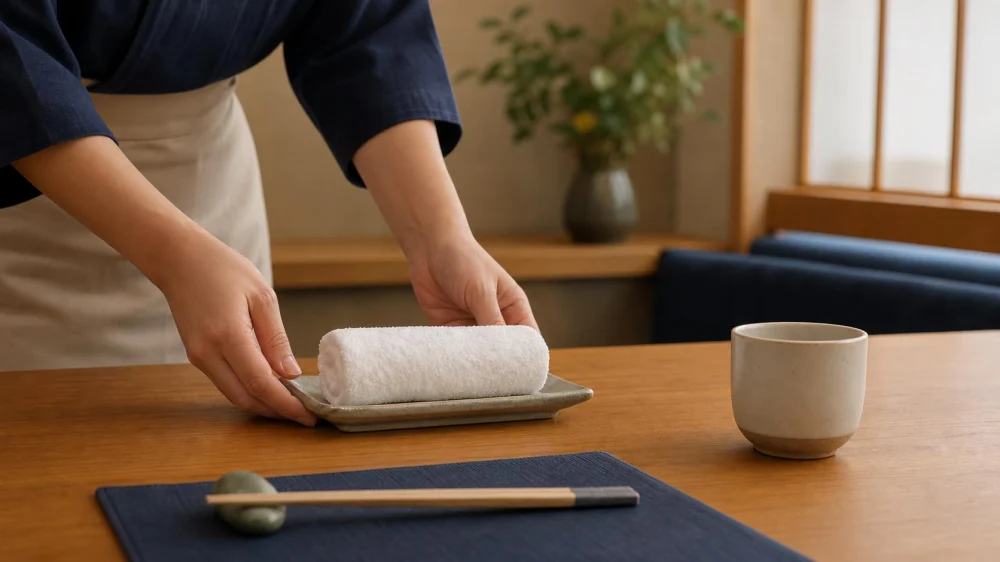
The towel offered before a meal at many Japanese restaurants is called an oshibori. Use it to clean your hands, then fold or roll it loosely and return it to its tray or wrapper. The safest restaurant etiquette is not to wipe the table, dishes, or spills with it. Warm and cool versions are both normal, and not every Japanese restaurant provides one.
What an oshibori is
An oshibori is a moistened hand towel offered to a guest before eating or drinking. The word commonly refers to a reusable cloth towel, but restaurants may provide a single-use paper or nonwoven version sealed in a packet.
In the United States, diners may encounter oshibori at sushi counters, izakaya-style restaurants, ramen shops, teishoku restaurants, and more formal Japanese dining rooms. Service varies by restaurant, so receiving one is not a test of authenticity or quality.
The towel may arrive on a small tray, in a basket, directly from a server, or inside a wrapper. It is usually presented before food, sometimes with water or tea.
Why restaurants offer one
The immediate purpose is practical: it lets guests refresh and clean their hands at the table. This can be especially welcome before handling chopsticks, small dishes, or food that may be eaten by hand.
The gesture also signals hospitality and a transition into the meal. A warm towel can feel comforting in cool weather, while a chilled towel can be refreshing in heat. The temperature is a service choice, not a different item with a separate rule.
An oshibori does not imply that every course should be handled with the hands, and it is not a cleaning rag for the place setting. It is best understood as a personal hand towel provided for one guest.
How to use an oshibori politely
- Accept it naturally. A brief thank-you is enough. If it is in a packet, open the packet without scattering the wrapper across the table.
- Check the temperature. Very warm towels can feel hotter at the center. Unroll it carefully rather than pressing it immediately against the skin.
- Wipe your hands. Clean both hands quietly. There is no need for an elaborate motion.
- Refold it loosely. It does not have to return to its exact original roll. A neat fold keeps the setting organized.
- Return it to its place. Put it on the tray, in the basket, or on the opened wrapper rather than on a plate.
In casual settings, customs can be relaxed, but visitors who want a safe default should use the towel for hands only. Avoid wiping your face, neck, table, utensils, or a spill unless restaurant staff specifically indicates that use. Ask the server for a napkin or cleaning help instead.
Warm, cool, cloth, and disposable versions
A cloth oshibori usually feels thicker and may retain heat or cold longer. A disposable version is compact and convenient, especially for takeout, quick service, or locations that do not use a linen service.
Warm towels are common but not universal. A restaurant may choose cool towels because of season, climate, service style, or guest comfort. Neither temperature is more correct.
If a cloth towel comes with tongs or on a tray, use the presentation as provided. If a disposable packet includes a wrapper, leave the used towel on that wrapper so moisture does not spread across the table.
Hygiene and practical considerations
An oshibori can remove some visible residue and refresh the hands, but it is not a substitute for washing with soap and water when hands are visibly dirty or after using the restroom. Follow ordinary food-safety habits even when a towel is provided.
Restaurants may use professionally processed reusable towels or sealed single-use products. Diners generally cannot verify the full handling process from appearance alone. If a towel looks soiled, smells unusual, or seems uncomfortably hot, do not use it; politely request a replacement or decline.
People with sensitive skin, fragrance sensitivity, an open cut, or a relevant allergy can skip the towel. Ask whether the product is scented if that matters. Do not use a shared towel; each oshibori is intended for an individual guest.
The larger cultural context
Oshibori are not limited to restaurants. Similar towels may appear in hospitality settings, transport services, cafés, or meeting spaces in Japan. The shared idea is welcoming a guest with a chance to refresh.
Practices evolve and differ among businesses. A fine-dining counter, neighborhood restaurant, and American Japanese chain may present the towel differently. Treat the staff’s service pattern as the best local cue rather than insisting on one universal ritual.
Respectful dining does not require performing Japanese identity or using memorized phrases. Simple observation, clean hands, and consideration for staff and other diners are more useful than trying to display expertise.
Sources and evidence notes
This article describes widely recognized hospitality practice around oshibori: the item is a moist hand towel, it may be warm or cool, and it is commonly returned to its tray or wrapper after use. Exact presentation and etiquette can vary by venue and level of formality.
Hygiene notes follow broad food-safety principles. A damp towel provides convenience but does not replace appropriate handwashing. For allergy or infection concerns, use personal medical guidance and speak with restaurant staff about the specific product.
Frequently asked questions
Do I use an oshibori before or during the meal?
Use it when it is presented, usually before eating. Leave it neatly in its place afterward. You may use it again for your hands if appropriate, but do not treat it as a general-purpose napkin.
Is it rude to decline the towel?
No. You can leave it unused or politely decline, especially for skin sensitivity or personal preference. Handle the interaction simply without criticizing the service.
Can I wipe my face with a hot towel?
Some people do so in casual contexts, but hands-only is the safest default in a restaurant, particularly at a formal meal. It also avoids transferring cosmetics, oil, or soil to a reusable towel.
What should I do with the plastic wrapper?
Open it neatly and keep the wrapper near the used disposable towel until staff clears it. Do not put the wet towel on a food plate or inside a drinking cup.
Why did my Japanese restaurant not offer an oshibori?
Service styles differ. The restaurant may use napkins, reserve towels for certain meals, or simply not provide them. Their absence does not by itself indicate poor service or inauthentic food.
Conclusion and next steps
When an oshibori arrives, unroll it carefully, clean your hands, fold it loosely, and return it to its tray or wrapper. That small sequence is enough. Follow the restaurant’s cues, use a napkin for your mouth and spills, and enjoy the towel as a practical gesture of welcome rather than a complicated etiquette challenge.




 Osaka Asian Fusion4.0 (262 reviews)
 Musashi Japanese Steakhouse4.0 (461 reviews)
 Kanamizu Japanese Restaurant4.0 (80 reviews)
 Flying Ninja4.0 (640 reviews)
 Sachi Sushi4.0 (182 reviews)
 Jingdu Japanese Buffet4.0 (2430 reviews)
 Signature Sushi and Ramen at Suteishi Japanese Restaurant
 What Is Tsukemen? Dipping Ramen Explained vs Traditional Japanese Noodle Soup
 Top Dishes You Should Order at Midori Japanese Restaurant
 Why Locals Recommend Hiro Japanese Restaurant – Authentic Japanese Dining Experience
 Why Hanaoka Japanese Restaurant Is a Must-Try Spot for Japanese Food Lovers
 A Foodie’s Experience at Hayashi Japanese Restaurant