
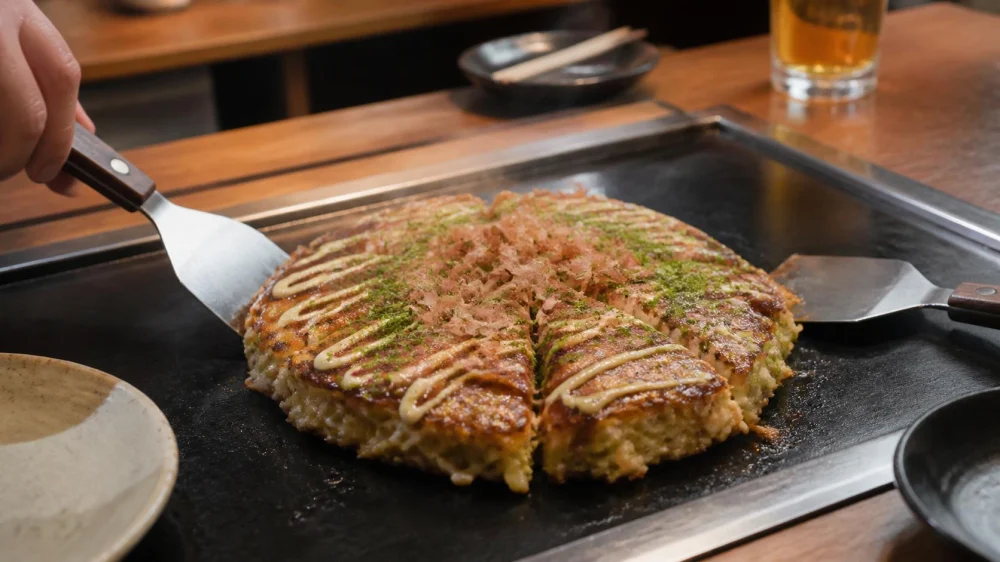
Okonomiyaki Guide: Styles, Toppings, and Table Etiquette
On this page
Quick answer
Okonomiyaki is a savory Japanese griddle dish built around batter and cabbage, with ingredients and preparation varying by region and restaurant. Osaka-style versions usually mix ingredients before cooking, while Hiroshima-style versions layer them and often include noodles. Choose a house style, confirm who cooks it, add toppings in moderation, and use the small spatula without touching a hot griddle.
What okonomiyaki is
Okonomiyaki is sometimes compared with a savory pancake, but that shorthand does not capture its cabbage-rich texture, sauces, toppings, and regional methods. The name suggests selecting what you like and grilling it, though restaurant menus usually offer established combinations.
Common components include flour-based batter, cabbage, egg, pork, seafood, green onion, or other additions. Finished dishes may receive savory sauce, mayonnaise, dried seaweed, and thin bonito flakes. Exact recipes vary widely.
Major styles
Osaka or Kansai style generally mixes cabbage and other core ingredients into the batter before the round is cooked on both sides. It is cohesive, thick, and easy to divide into wedges.
Hiroshima style generally layers batter, cabbage, fillings, and often noodles rather than mixing everything together. The layered construction creates a different texture and usually requires more practiced griddle work.
Restaurants may offer local interpretations, modern toppings, or their own house format. Treat the menu description as the authority for what a particular dish contains.
How to order
- Identify the house style. Ask whether ingredients are mixed, layered, or prepared another way.
- Choose one main combination. Pork, seafood, mixed, or vegetable-centered options are common. Too many additions can hide the base texture.
- Check noodles and portion size. Some styles include noodles and can be more filling than expected.
- Confirm who cooks. Staff may prepare it in the kitchen, cook it at your table, or give instructions for self-cooking.
- Discuss allergens and dietary needs. Batter, sauce, mayonnaise, stock, seafood, and shared griddles can matter.
Cooking and eating etiquette
If staff cook the dish, avoid moving or pressing it unless invited. When self-cooking is expected, follow the restaurant’s timing and flipping instructions rather than guessing. Griddles and spatulas can remain extremely hot.
- Divide the finished okonomiyaki into manageable sections with the provided spatula.
- Transfer a portion to your plate, or eat small pieces as the restaurant demonstrates.
- Keep utensil handles away from the active cooking surface.
- Add extra sauce or toppings only after tasting the restaurant’s balance.
- Share by dividing clean sections rather than repeatedly cutting across the whole dish.
It is best for a casual, savory meal and group sharing when portions allow. It may be less suitable for diners avoiding gluten, egg, seafood, or cross-contact unless the restaurant can explain ingredients and preparation.
Important notes
Do not assume a vegetable-labeled version is vegetarian or vegan. Batter, dashi, sauce, bonito flakes, mayonnaise, or the shared griddle may include or contact animal products. Wheat, egg, soy, fish, shellfish, and other allergens may be present.
For self-cooking, prioritize the restaurant’s safety directions. Children and anyone with limited reach should be seated away from exposed hot surfaces when possible.
Sources and evidence notes
The style distinctions and serving guidance reflect common Japanese restaurant practice. Recipes and regional identities are diverse, so no single ingredient list describes every okonomiyaki. The restaurant is the proper source for its preparation, allergens, and griddle rules.
Frequently asked questions
Is okonomiyaki the same as a pancake?
It shares a round griddled form, but it is a savory cabbage-based dish with its own ingredients, texture, sauces, and regional methods.
Does okonomiyaki always include noodles?
No. Noodles are strongly associated with Hiroshima-style preparations, while mixed Osaka-style versions usually do not require them.
Do I need to cook it myself?
It depends on the restaurant. Ask before touching the batter or griddle; many places cook it fully for guests.
Why do the flakes on top move?
Very thin bonito flakes can shift in rising heat and steam. The movement is not a sign that the food is alive.
Next steps
Choose the regional or house style that appeals to you, confirm portion size and cooking responsibility, and ask about hidden ingredients. Taste the finished dish before adding condiments, handle the griddle carefully, and compare the mixed and layered styles on separate visits if you want to understand the difference.
 Piramida Restaurant4.0 (206 reviews)
 Ohana Hut4.0 (140 reviews)
 Oops! Sushi & Sake Bar4.0 (324 reviews)
 Kami Asian4.0 (88 reviews)
 Fushimi4.0 (633 reviews)
 Tokyo Teriyaki & Wok3.0 (286 reviews)
 An Insider’s Review of Kiku Japanese Restaurant
 Why Locals Recommend Akira Japanese Restaurant: A Guide to Authentic Japanese Dining
 The Complete Guide to Dining at Shima Japanese Restaurant
 How to Make Vegan Ramen With Miso Broth: Easy Plant-Based Japanese Soup
 How to Say Restaurant in Japanese and Use It Like a Local
 Signature Sushi and Ramen at Shima Japanese Restaurant