
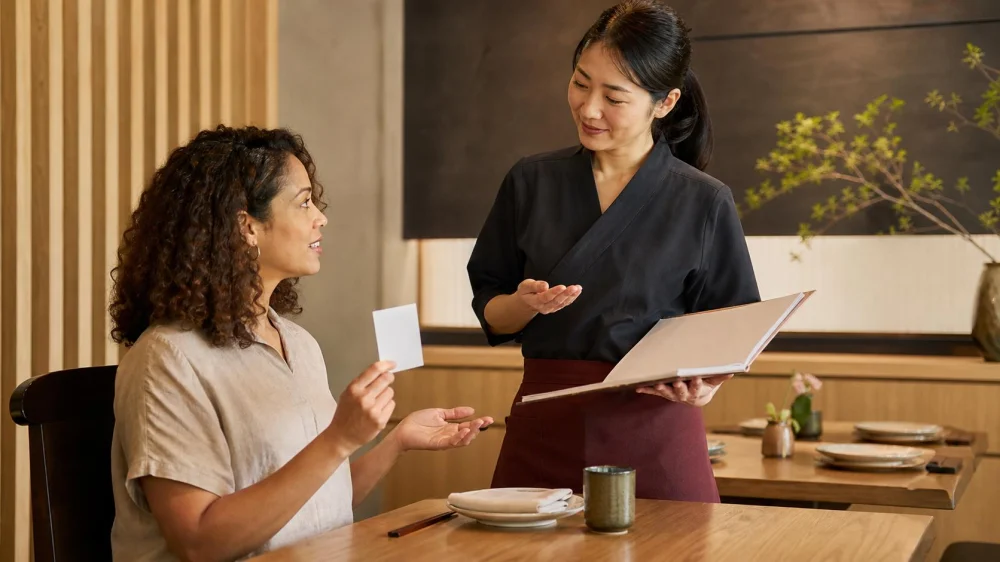
Dining With Food Allergies at a Japanese Restaurant
On this page
Quick answer
If you have a food allergy, contact the Japanese restaurant before visiting, name the exact allergen and reaction risk, and ask whether staff can verify ingredients and manage cross-contact. Repeat the conversation when ordering. Do not assume a plain-looking broth, sauce, seasoning, garnish, or fried item is allergen-free, and never treat staff reassurance as a medical guarantee.
This guide is for US diners with diagnosed food allergies and their companions. It supports clearer restaurant conversations but cannot determine whether a specific kitchen or dish is safe for you. Follow your clinician's allergy action plan and carry prescribed emergency medication.
Why ingredients can be hard to spot
Cross-contact happens when an allergen is unintentionally transferred to another food through hands, utensils, oil, grills, cutting boards, containers, or surfaces. Removing a visible garnish does not reverse cross-contact.
Japanese dishes often build flavor through broths, marinades, dipping sauces, seasoning blends, and prepared components. A dish name alone may not reveal every ingredient. Soy, wheat, fish, shellfish, egg, sesame, milk, peanuts, or tree nuts may appear in recipes or shared preparation areas, but recipes vary and this list is not exhaustive.
- Broth and soup bases may combine several prepared ingredients.
- Soy sauce and other seasonings may contain wheat or other allergens.
- Fried foods may share batter equipment, fryers, or oil.
- Sushi counters may reuse knives, boards, gloves, or sauces across orders.
- Packaged toppings and desserts can change by supplier.
What to do before the visit
- Call at a quieter time. Ask for a manager or kitchen lead who can explain ingredients and preparation.
- Use precise language. Say “I have a food allergy to…” rather than “I do not like” or “I avoid.” Name every relevant allergen.
- Describe the required control. Ask about separate clean utensils, surfaces, gloves, oil, grills, and ingredient containers where relevant.
- Ask how recipes are verified. Find out whether labels, recipe records, or a knowledgeable cook can be checked for the shift you plan to visit.
- Accept uncertainty. If the restaurant cannot confidently verify ingredients or cross-contact controls, choose another place or do not eat.
A translation card can support communication but should not replace a two-way conversation. Keep the original allergen names and emergency information available. Online menus and reviews may be outdated and cannot confirm the current kitchen process.
Ordering and communication checklist
Tell the server about the allergy before ordering, even if you called ahead. Ask them to notify the kitchen and mark the ticket according to restaurant procedure. Choose a simple dish only after its ingredients and preparation are verified; “simple” does not automatically mean safer.
- Confirm sauces, broths, marinades, dressings, garnishes, and cooking oil.
- Ask whether a shared fryer, grill, pot, cutting board, or utensil is used.
- Avoid requesting an improvised substitution that staff cannot verify.
- When food arrives, confirm that it is the allergy-aware order.
- Stop eating and ask questions if the appearance or garnish is unexpected.
Companions should understand that sharing plates, chopsticks, sauces, or drinks can introduce allergens. Keep the allergic diner's place setting separate when that is part of the safety plan.
Important safety notes
Symptoms of a severe allergic reaction can develop quickly and may include breathing difficulty, throat tightness, widespread hives, vomiting, dizziness, or fainting. Follow the person's emergency plan, use prescribed epinephrine as directed, and call 911. Antihistamines are not a substitute for epinephrine in anaphylaxis.
People with celiac disease, food intolerance, religious restrictions, or dietary preferences may ask some of the same ingredient questions, but the medical risks and required controls are not identical. Describe the actual need rather than borrowing an allergy label.
Sources and evidence notes
This article reflects broad food-allergy safety guidance and common restaurant cross-contact principles. Recipes, suppliers, staff knowledge, and equipment differ by establishment and shift. Current ingredient labels, kitchen procedures, the restaurant's direct answers, and a clinician-provided action plan are the relevant sources for an individual decision.
Frequently asked questions
Is gluten-free soy sauce enough for a wheat allergy?
Not by itself. The complete recipe, brand label, other ingredients, and cross-contact controls still matter. Ask the restaurant to verify the product and preparation.
Is sashimi automatically allergy-safe?
No. The seafood itself may be an allergen, and knives, boards, gloves, garnishes, and sauces may contact other ingredients.
Can a restaurant guarantee zero cross-contact?
Many shared kitchens cannot make that guarantee. Ask what controls are actually possible and decide with your medical guidance and risk tolerance.
Should I bring my prescribed epinephrine?
Yes, if it is part of your clinician's plan. Keep it accessible, check its condition and expiration, and ensure companions know where it is.
Next steps
Before choosing a restaurant, write the exact allergen, cross-contact questions, and emergency plan. Call the restaurant, document only what staff can confirm, repeat the discussion on arrival, and be prepared to leave if the kitchen cannot safely meet the need.


 Fuwa Teriyaki Grill3.0 (32 reviews)
 Masa Hibachi Sushi & Bar4.0 (984 reviews)
 Jimoto4.0 (82 reviews)
 Teriyaki One4.0 (432 reviews)
 Sarku Japan3.0 (315 reviews)
 Yoshi sushi0.0 (0 reviews)
 A Foodie’s Experience at Best Japanese Restaurants Near Me
 The Complete Guide to Dining at Good Japanese Restaurants in NYC
 Vegetarian Japanese Restaurant Guide: Sushi, Ramen & Plant-Based Plates
 Why Locals Recommend Hanaoka Japanese Restaurant: Top Reasons to Visit
 What Salad Dressing Is Used in Japanese Restaurants?
 What to Look for in a Quality Japanese Restaurant Near Me: Red & Green Flags